Here are two of the lines that we offer in this moment:
Researchers: María Dolores Gómez, Miguel A. Pérez-Amador.
Project: Study of the function of DELLA proteins in seed size control. Designing larger seeds.
According to the FAO, one of the greatest challenges we face is achieving an increase in agricultural crop yield in order to meet the food requirements of a constantly growing population. Moreover, this goal is even more complex when we take into account the changes brought about by climate change. To achieve it, it is essential to understand the molecular bases that determine seed production and quality, since seeds are the main foundation of human nutrition, particularly cereal and legume seeds.
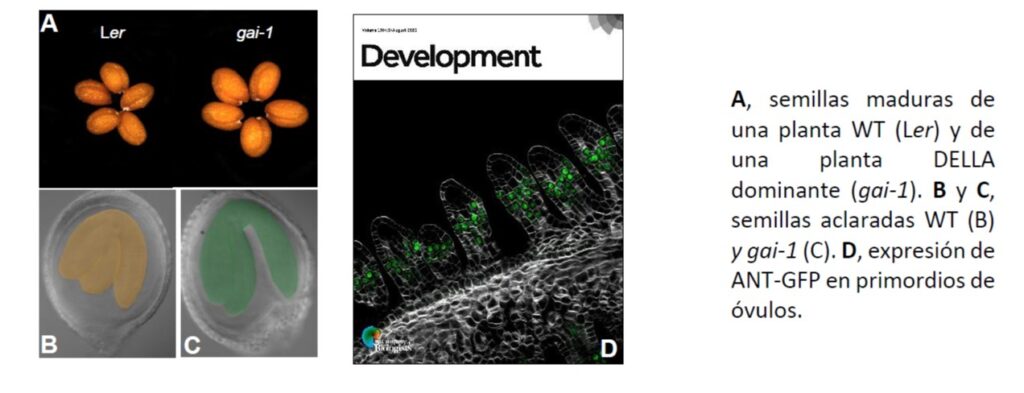
Gibberellins (GAs) are plant hormones that regulate numerous physiological processes such as germination, stem elongation, flowering, and fruiting. Genetic and molecular studies have enabled the identification of the components involved in the GA perception and signaling cascade, with DELLA proteins being the most relevant. DELLA proteins are repressors of GA signaling that regulate GA-promoted growth and differentiation. At the molecular level, these proteins are transcriptional regulators that act as activators or repressors through interactions with other transcription factors. Our group has demonstrated the involvement of DELLA proteins as positive regulators of seed size, such that dominant DELLA mutants produce larger seeds. Our current objective is to understand how DELLA proteins regulate seed size at the molecular level in Arabidopsis, with the aim of using this knowledge to increase the yield of agronomically important species such as Camelina sativa.
Contact information: mdgomez@ibmcp.upv.es, mpereza@ibmcp.upv.es
Researchers: Pablo Tornero and Miguel Á. Pérez-Amador.
Project: Genetics of seed size in Arabidopsis. GAI and its interactions.
As mentioned in the other Master’s Thesis project offered by our laboratory, the gain-of-function mutant gai-1 has a larger seed size than the wild type. In addition, plants carrying this mutation are more drought-resistant. However, on the negative side, gai-1 plants are smaller and grow slowly. The aim of this work is to identify the genetic interactions between gai-1 and other Arabidopsis seed-size mutants.
On one hand, we are generating double mutants between gai-1 and previously described mutants to measure the size of the resulting seeds. This will allow us to describe genetic interactions that position GAI within the signaling network controlling seed size.
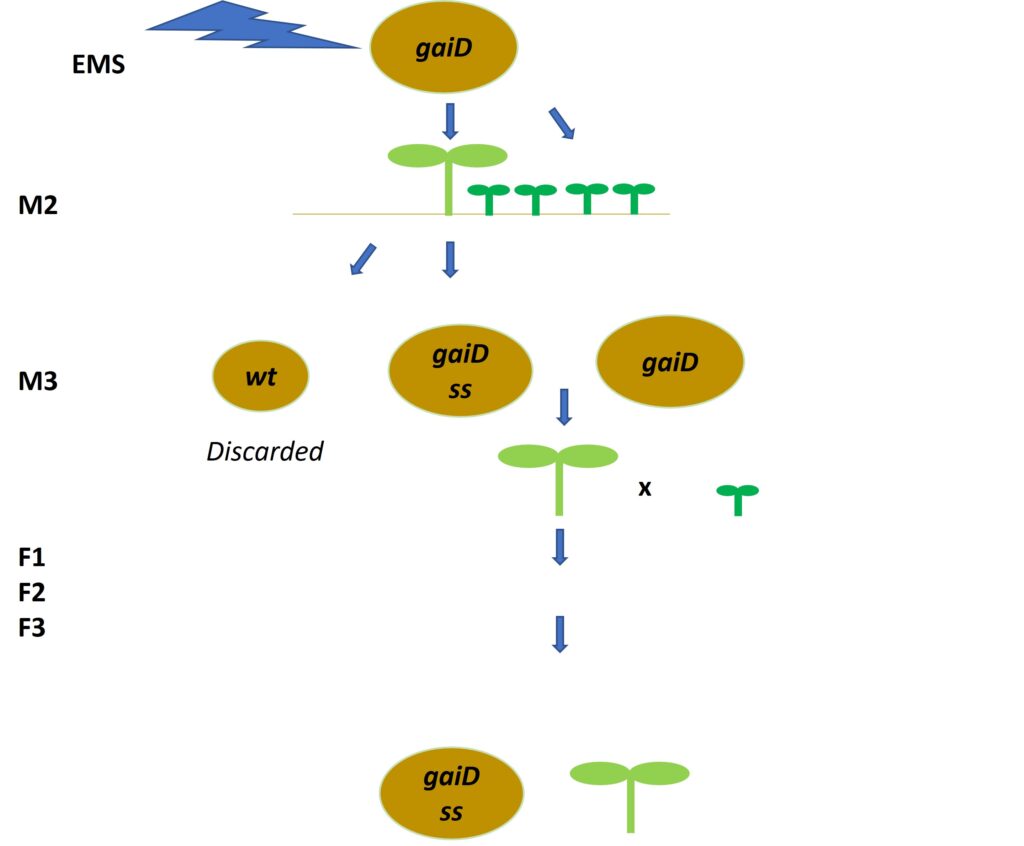
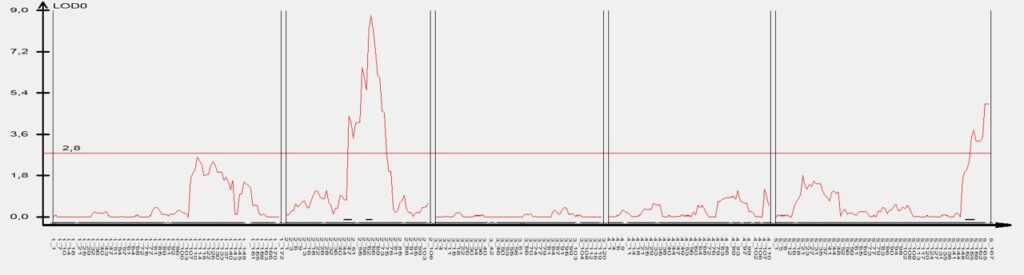
On the other hand, we are screening for mutations in a gai-1 background. By searching for seeds larger than those of gai-1 itself, we hope to identify the genes that execute the gai-1 signal. As mentioned, gai-1 plants are smaller, so we are also looking for mutations that revert this phenotype without affecting seed size. In other words, we want to understand how larger seeds are produced and whether this phenotype can be separated from the one causing smaller plants. Therefore, we propose a purely scientific objective that also has a clear biotechnological application.
The techniques to be used in this work will be those typical of molecular biology, genetics, and bioinformatics.
Contact information: ptornero@ibmcp.upv.es, mpereza@ibmcp.upv.es